Posts

Showing posts with the label new york times

NYT: Growing Up On Facebook

Image
I'm very interested in the process and journey of personal development, particularly the challenge of leaving behind old behaviors, mental maps, and self-definitions. I'm also interested in how that process plays out in interpersonal relationships, having observed how difficult it can be for other people to see you as the person you've become as opposed to the person you've always been (for them). Peggy Orenstein's article in today's New York Times, Growing Up On Facebook , touches on these issues and how they may play out at a time when we increasingly share the details (minutiae?) of our lives on facebook, twitter, blogs (!), etc.. Orenstein writes: college was my big chance to doff the roles in my family and community that I had outgrown, to reinvent myself, to get busy with the embarrassing, exciting, muddy, wonderful work of creating an adult identity. Can you really do that with your 450 closest friends watching, all tweeting to affirm ad nauseam your pres...

Seltzer and Evaporating Clouds

I've had the great pleasure over the past year to work on a key strategic project with some consultants from the Goldratt Group (including a trip to Amsterdam last year (to work directly with Eli Goldratt - see Jamming With Eli ). David Leonhardt's Economic Scene column in today's New York Times ( To Spend or to Save? Trick Question ) addresses the conflict many people are feeling right now between spending and saving; the paradox is that we need spending to improve the state of the economy, but we need savings to reduce personal debt, recapitalize banks, etc. Given all that, it's hard to know what to do, and the natural instinct is to hunker down and stop spending any more than is absolutely necessary. Leonhardt writes: It’s your fault. Part of it is, anyway. You, the American consumer, spent too much money. You bought too much house, took on too much debt and generally lived beyond your means. Your free-spending ways helped cause the worst financial crisis since the G...

Ice Skating on Candlewood Lake

Image
From Outdoors On The Frozen Lake - January 2009 From Outdoors On The Frozen Lake - January 2009 From Outdoors On The Frozen Lake - January 2009 Had the first chance recently in my 40+ years to make an ice skating rink on a frozen lake - see the pictures above. Nice article in the NYT about the weather being cold enough this year for lots of ice skating in the area: Skate, Sure, but Don’t Expect a Zamboni . We could have used a Zamboni to smooth out the ice, but I don't think the kids cared much....

On (Back) Pain

Image
I recently came across two articles that were relevant given that lower back pain has been one feature of my post-marathon suffering (not much progress on that front, by the way). Jonah Lehrer, author of How We Decide , has an article which discusses research showing that the solution to back pain is often psychological rather than physical. An entry yesterday in the New York Times Well blog came at the back pain problem from a slightly different angle. Scans For Back Pain Ineffective addresses research showing that scanning (x-rays/MRIs/CT scans) to find the source of back pain are often ineffective because those interpreting results often fail to account for the normal effects of aging and time. Both are worth a read. I did laugh at this quote from the Lehrer article: Chronic stress is another important risk factor for chronic pain. One back surgeon, who wished to remain anonymous for fear of offending his patients, said that he's seen several men develop lower back pain shortly...

New David Leonhardt Article on Facing Our Economic Challenges

At the New York Times, an early article from next Sunday's Magazine: The Big Fix . Absolutely worth a read. From the concluding paragraphs: The norms of the last two decades or so — consume before invest; worry about the short term, not the long term — have been more than just a reflection of the economy. They have also affected the economy. Chief executives have fought for paychecks that their predecessors would have considered obscenely large. Technocrats inside Washington’s regulatory agencies, after listening to their bosses talk endlessly about the dangers of overregulation, made quite sure that they weren’t regulating too much. Financial engineering became a more appealing career track than actual engineering or science. In one of the small gems in their book, Goldin and Katz write that towns and cities with a large elderly population once devoted a higher-than-average share of their taxes to schools. Apparently, age made them see the benefits of education. In recent decades,...

Inspiration

Image
From the New York Times: Fitness Isn't An Overnight Sensation . Terrific article on the benefits of exercise and the commitment required to make a difference. Here's one great story from the article: Then there’s Charles Reilly, a federal prosecutor in Manhattan and a marathon runner who took a 10-year hiatus from the sport when he joined his local school board. He just did not have time to exercise, he said. Along with exercising less, he ate more. Soon he ballooned from 159 pounds to 282. “It came on gradually, but it came on,” Mr. Reilly said of the weight. On April 18, 2005, he had his last school board meeting — he’d decided not to run for any more terms. Eight days later, he went out for a run. “After half a mile, I had to stop and walk,” Mr. Reilly said. But he kept trying. A month later, he could run three miles without stopping. After three or four months, he says, he could run for five miles. By the end of 2006, he ran 10 miles. In the meantime, he also changed his di...

Why Does U.S. Health Care Cost So Much? (Part I) - Economix Blog - NYTimes.com

Image
There's an excellent series of short articles on health care in the US on the New York Times web site - definitely worth a read. I think it's important to become familiar with the issues given that health care improvement is one of the stated goals of the new President. Links to the series are below. If you have any recommendations of other good writing on health care, let me know in the comments. Speaking of comments - be sure to check out the comments in each of these blog posts. Why Does U.S. Health Care Cost So Much? (Part I) - Economix Blog - NYTimes.com Why Does U.S. Health Care Cost So Much? (Part II: Indefensible Administrative Costs) Why Does U.S. Health Care Cost So Much? (Part III: An Aging Population Isn’t the Reason) Why Does U.S. Health Care Cost So Much? (Part IV: A Primer on Medicare) U.S. Health Care Costs, Part V: Can Americans Afford Medicare? U.S. Health Care Costs Part VI: At What Price Physician Autonomy? U.S. Health Care Costs Part VII: Reining in Doctors...

No More Excuses

Image
According to Don't Starve A Cold Of Exercise by Gina Kolata in the New York Times, the little bit of research that has been done to date suggests that one should not skip workouts while sick. The studies which were done don't sound to me like much fun given that the subjects were 'deliberately infected with a rhinovirus' and the researchers 'collected the subjects’ used facial tissues'....

Much More Than We Needed To Know....

....but interesting nonetheless: Providing Toilets for 39,000 Runners

Thank you Mrs. Longest Run!

Dear Mrs. Longest Run: there are others who know your pain: For Those Not Running, Training Can Be Just as Taxing .

Preventing 'Asynchronous' Communication

In case one is Drunk, and Dangerous, at the Keyboard - Mail Goggles. Hilarious!

The New York Times Recommend Button

Image
Most of you know I love to read and share articles. While the web has made sharing a lot easier (no more cutting out an article, photocopying, etc.) it's still not a totally seamless process (do I share on The Longest Run? via email? on facebook?). A few weeks ago the New York Times launched a new community feature - called Times People - which enables readers to 'recommend' articles - you can find a recommend button in the box which usually appears on the top right hand side of articles on the web site (with buttons to print, email, save, share, etc.) as well as at the bottom of articles. There's an extensive FAQ on the NYT site - ( see: Times People FAQ ) - which describes the feature in detail as well as how to use it. I'm enjoying the feature so far, though it's far less interesting if others aren't using it as well (few are seeing my recommendations and I'm not seeing recommendations from many others). I'm set up as aweber9 for those of you who...

See This Show!

Image
I had the chance last week to see a preview performance of a show called Clay at The Duke Theater on 42nd Street; the show is directed by a friend we met many years ago in Chicago. The New York Times theater critic reviewed the show this week and seems to have enjoyed it (see Hip-Hop Coming of Age for Suburban Prince Hal ). The NYT site has an audio slide show which will give you a sense of the look and feel of the show. We loved it and plan to see it again during what is planned to be a short run. I can't recommend it highly enough. The show is about 80 minutes long and tickets aren't expensive....so go see it!

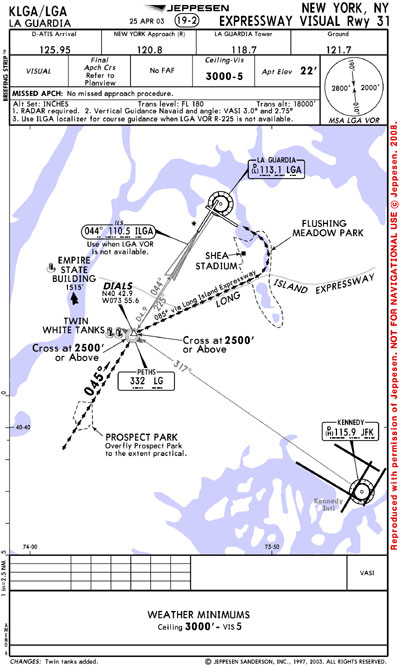
Flying To New York Via The Expressway Visual

Image
From Jeppesen/New York Times 9/26/08 I did a lot of traveling early in my career, flying often between New York City and Chicago. I distinctly remember the sharp left turn described in this New York Times article about pilots and Shea Stadium ( To Pilots, Shea Is Less Ballpark Than Landmark ). Truth be told, the big left turn is a bit scary as it's a sharp turn at low altitude; if you're sitting on the left hand side of the plane and can see the airport, you wonder how the plane will manage to get lined up in time to land.

The Experience of a Lifetime

Image
I was initially disappointed to learn that the Chicago Marathon bans headphones during the race as I have always run with music and find it's a great motivational boost. Now that I know for sure my friend Chris and I will be running together I wouldn't be using an ipod in any case, though this article from the New York Times has a good perspective on the topic. According to Mary Wittenberg, who is in charge of the New York Road Runners: "Our overwhelming concern is safety, but I think somebody is crazy to wear an iPod at this marathon for other reasons,” she said. “You want every single sense tuned in to the experience of running the race of a lifetime."

NYT On Too Much Training

Good article by Gina Kolata: When Training Backfires: Hard Work That’s Too Hard .

More on Ambient Intimacy

I first heard of the concept of ambient intimacy back in May. In the New York Times Sunday Magazine, Clive Thompson writes about the Brave New World Of Digital Intimacy . I found the article to be a thoughtful look at the possibilities and challenges of connecting with others online.

Running Down A Dream Does It Again & the NYC Half-Marathon

Image
Running Down A Dream calls out a pair of New York Times articles on half-marathons in Half Marathons are So Hot Right Now . You can find the NYT articles here and here . I'll be running in the NYC Half this weekend. Here's what I have to look forward to: Central Park At the Start, runners and spectators will hear the singing of the national anthem. NIKE Sponge Station - (Seventh Avenue btw 54th-55th Streets) Stay cool at the Nike sponge station. Times Square Sing-A-Long - (Eastside of Broadway and 44th Street) At 44th street and Broadway, spectators and runners alike will have the opportunity to sing along with Broadway performers as they belt out favorite classic songs. Don’t worry about forgetting the lyrics; they’ll be displayed on a giant video screen that will also feature a live runner cam. Who: Broadway performers Catherine Porter, Ben Roseberry, Susan Spencer and Matthew Stocke along with over 10,000 runners running through Times Square What: Sing-a-long to all-time f...

Is It Possible To 'Beat The Heat'?

Very relevant article in the New York Times on exercising when it's hot and humid: To Beat the Heat, Learn to Sweat It Out . Lots of information on why we're affected by the heat and humidity but unfortunately there's not much to be done other than just getting used to it, or as the article says: "Heat is the X factor. Sometimes you have to just forget it and move on."

A New Angle

Image
Here's a short piece from the New York Times on exploring new running routes in Central Park: Out of the Loop and on the Run in Central Park ; there's a great map of alternative routes; I especially like the one that's longer than the 6 mile loop - important when you're trying to accumulate a lot of miles. The article also has a picture of my nemesis ; it's shot from a different angle from my picture.